Over the past five years, the Science of Reading has gained serious momentum. Teachers have built a much deeper understanding of how kids actually learn to read, but for many, the question is: now what? Much of the curriculum available still doesn’t fully align with that research, leaving teachers to figure it out on their own.
Teachers shouldn’t have to be both the composer and the conductor, creating lessons from scratch and delivering them every day. Teachers should spend their time refining their skill, bringing great instruction to life, not scrambling to build it.
The Word Mapping Project curriculum was built to change that.
The Word Mapping Project curriculum connects sound, spelling, and meaning so students can map words into long-term memory. And not just any words. High-utility descriptive and academic vocabulary that drives reading, writing, and learning.
My Story
I didn’t start as a teacher. I spent 8 years as a school psychologist before transitioning into the classroom, where I’ve now been teaching for the past 18 years. From the beginning, I was drawn to vocabulary instruction. For my very first teaching lesson (my interview lesson), I used ideas from the book Bringing Words to Life and taught the words drowsy and reluctant using A Pocket for Corduroy.
It went really well (I was offered a first grade teaching position). It also taught me something important: When you have the right structure and routines, good teaching becomes much more doable, motivating, and honestly rewarding.
At the heart of the Word Mapping Project curriculum are clear, consistent routines that bring everything together. Students work with morphology to understand how words are built, engage in explicit vocabulary instruction to deeply learn high-utility words, and practice spelling to connect sound and structure. Lessons are reinforced through fluency work, retrieval practice, and structured writing, so students don’t just see words once—they revisit and use them in meaningful ways. Everything is designed to fit into a manageable daily routine, so the learning sticks and builds over time.
Here is an example from my 5th grade class. Students practiced spelling the word inconspicuousness and then were told to write down any previously learned words that were associated with the word inconspicuousness. Students wrote words such as abscond, subtle, and humble. These are not synonyms, but have a connection with one another. So, I asked students how all of these words were related.
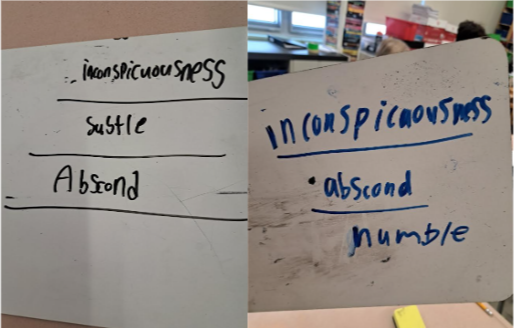
Pretty much every single student in the classroom connected the words right away. They all have to do with being hidden or not easily seen, and students quickly began to see how those meanings connected across different words. It is powerful when students are given the opportunity to make meaning-based connections instead of just memorizing definitions.
At its core, the Word Mapping Project curriculum is about helping students become logophiles (lovers of words). It’s about making students curious about words and confident in how language works. When students understand words, they can tackle more complex texts, have stronger conversations, and write more clearly.